The 28th meeting of the High-level Experts and Leaders Panel on Water and Disasters (HELP) was held on September 7, 2026 in Beijing, China. Our NARBO Chairperson, Dr. Ir. Imam Santoso, M. Sc delivered a keynote speech online as a member of HELP.
What is HELP?The HELP was established in 2007 by the UN Secretary-General’s Advisory Board on Water and Sanitation (UNSGAB) and then expanded in 2013 with aim to assist governments, the international communities, and stakeholders in addressing water-related disasters such as floods, droughts, tsunamis, and storm surges through mobilizing political will and resources. The HELP organizes the UN Special Session on Water and Disaster and provides ongoing policy advice to forums such as the Asia-Pacific Water Summit, the World Water Forum, and other high-level panels on water.
The HELP is currently working to mitigate water risks associated with climate change and promote comprehensive water management in preparation for the UN Water Conference 2026 which will be held in the United Arab Emirates (UAE) in December 2026.
Summary of the Keynote Speech delivered by Dr. Ir. Imam Santoso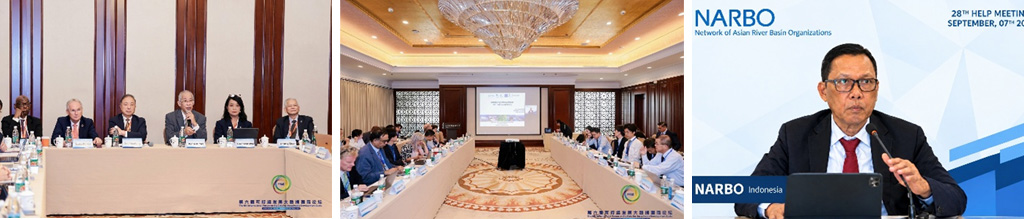
The following is a summary of the keynote speech by NARBO Chairperson, Dr. Ir. Imam Santoso, M. Sc.
The world is currently facing heightened uncertainty in water resources management due to the escalating impacts of climate change, which are causing heavy rainfall, prolonged droughts, and shifts in seasonal patterns.
In response to these challenges, the case of Indonesia’s Citarum River basin is highlighted. There, the coordinated operation of the Saguling, Cirata, and Jatiluhur cascade dam—leveraging meteorological and hydrological data—was implemented to secure water for domestic, agriculture, and power generation while stabilizing reservoir operations. This effort included a 50-day Weather Modification Operation (OMC) during the extended dry season of 2026.
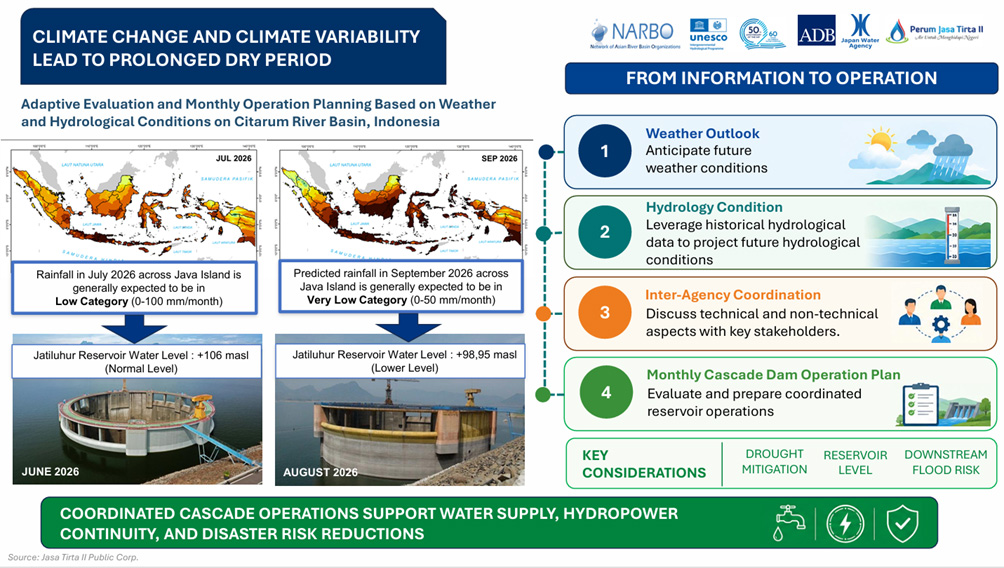
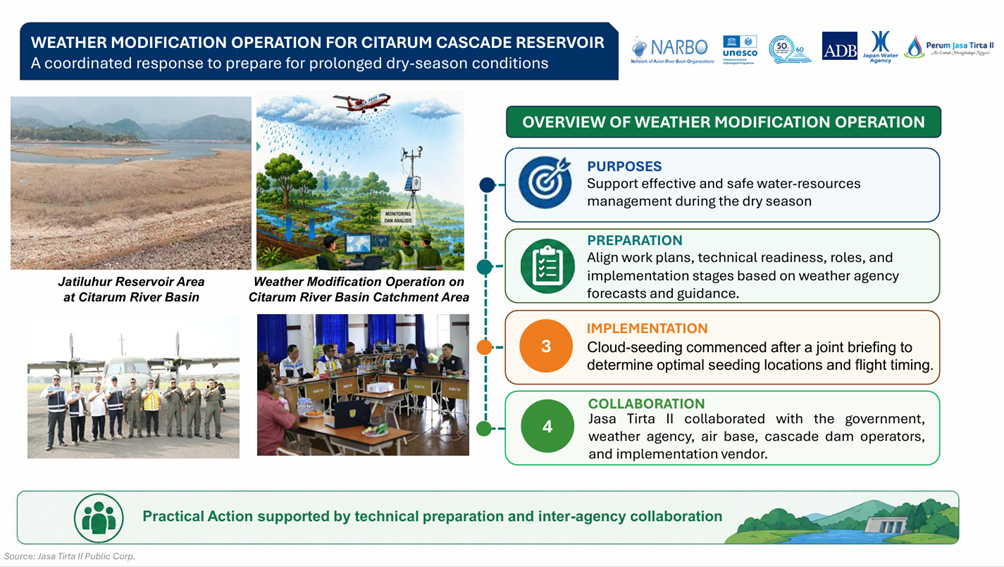
This case serves as an excellent example of flexible, adaptative river basin management that combines monitoring, inter-agency collaboration, and supplementary measures; it aligns with the direction of "Interactive Dialogue C (Water for Planet)" at the 2026 UN Water Conference.
Furthermore, water issues are closely intertwined not only with water usage but also with ecosystems, disaster risks, food and energy. Addressing them requires—in addition to infrastructure development—governance, financing, human resources, science and technology, reliable data, and cooperation among stakeholders.
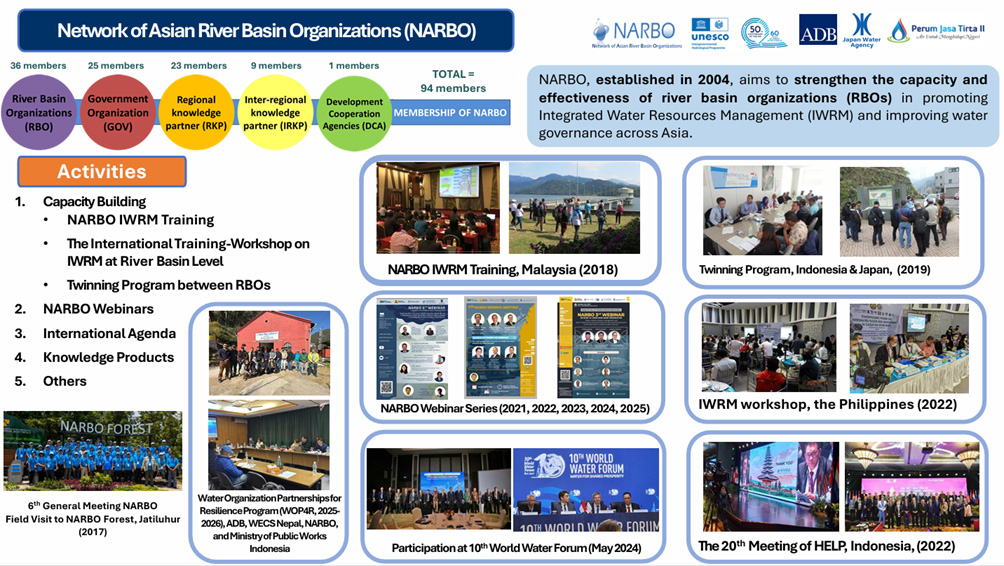
NARBO has supported IWRM capacity building of RBOs and other related agencies across various nations in Asian monsoon area through training, knowledge sharing, and mutual learning about flood and drought control, water supply, and environmental conservation.
Currently, NARBO is collaborating with UNESCO, the ADB, JWA, and Indonesia’s PJT II to revise the "Guidelines for IWRM at the River Basin Level." This initiative aims to enhance the IWRM capabilities across RBOs, etc. by incorporating the latest scientific knowledge, technologies, and practical experiences.
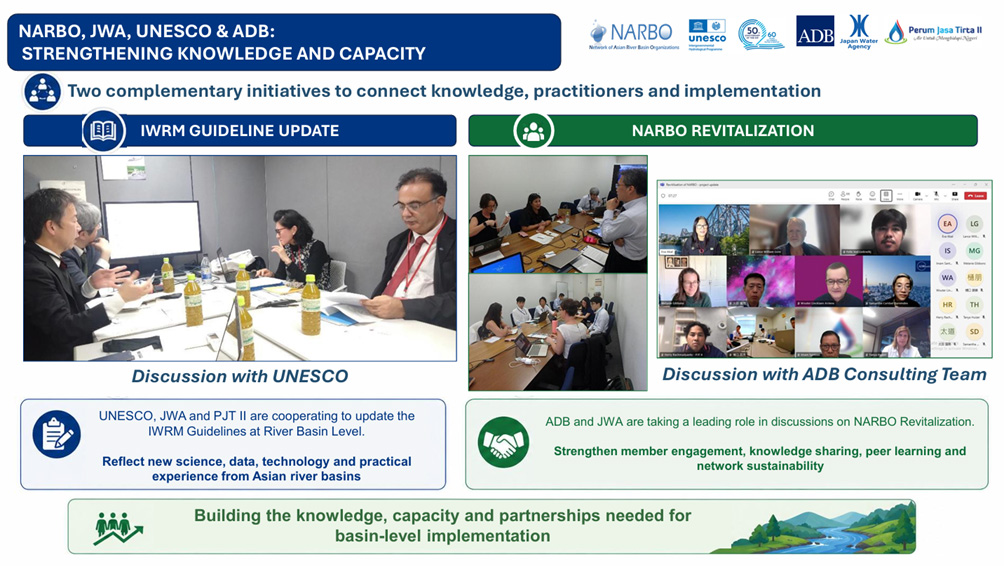
Moreover, NARBO is well-positioned to act as a bridge: disseminating the outcomes of the upcoming UN Water Conference to RBOs, etc. while sharing field-level experiences and lessons learned with the international community. The 2026 UN Water Conference should go beyond mere discussion and recommendations; the period from 2026 to 2028 should be designated as an "implementation phase," and it is crucial that not only new proposals but also actions taken in various river basins, their outcomes, and the lessons learned be shared among the relevant agencies and parties concerned in 2028.
NARBO will continuously contribute to the realization of sustainable water resources management by bridging the gap between international goals and on-the-ground practice, and by fostering practitioner capacity building and inter-organizational cooperation.